
In 2026, mobile robots will become the largest application market for precision planetary reducers
Mobile robotics will continue to drive growth in the precision planetary reducer market. According to Interact Analysis’s research on the precision reducer market, the rapidly growing mobile robotics sector will become the largest downstream application market for precision planetary reducers by 2026. Precision reducers feature low or zero backlash designs, meaning the gaps between their internal gears are much smaller than those of standard reducers. Furthermore, precision reducers are often connected to servo motors for applications requiring high-speed, precise motion. Therefore, the precision reducer market is closely linked to the motion control system market.
What factors are driving the growth of precision reducer products? The market for precision reducers and geared motors has experienced significant growth over the past few years. According to Interact Analysis, global reducer sales are expected to grow by 17% in 2022. By 2027, the market size is expected to exceed $5 billion, albeit at a slightly slower pace than in previous boom years. As a key component in motion control systems, the growth of the precision reducer market is primarily driven by increasing automation in manufacturing and the growth of the robotics market. However, it is also driven by excessive advance ordering and price increases. Recognizing the need for automation amidst labor shortages and fearing future price increases or supply chain issues that could impact delivery times, customers are placing orders in advance, leading to a significant backlog of orders for reducer manufacturers. Types of Precision Reducers Precision reducers can be primarily divided into three types: Planetary Reducers Harmonic Reducers Cycloid Reducers Over the past year, the market for harmonic and cycloid RV reducers has grown faster than the planetary reducer market, primarily driven by demand for robots. Harmonic and RV reducers are primarily used in multi-jointed robots and collaborative robots. Compared to the lowest-backlash, most “precise” harmonic and cycloid reducers typically used in industrial robots, precision planetary reducers have a broader application market, including the rapidly growing mobile robotics market. The precision reducer market continues to be dominated by planetary reducers. According to our research, less than 50% of all precision reducers sold globally in 2022 will be planetary reducers. Packaging machinery is the primary application area for planetary reducers, accounting for 14% of global sales. Metal cutting machine tools, semiconductor and electronic machinery, material handling, and industrial robots (primarily delta robots) follow closely behind in terms of sales share, demonstrating the breadth and diversity of the downstream market for planetary precision reducers. We forecast significant changes in the downstream market for planetary precision reducers between 2022 and 2026: The mobile robotics sector will see a significant increase in sales, becoming the largest downstream market by 2026, accounting for 18% of sales, significantly higher than the 4.3% in 2022. The figure below shows our forecasted sales share of the downstream market for planetary precision reducers in 2026. The figures in parentheses represent the market situation in 2022. It can be seen that packaging machinery is currently the largest application market for planetary reducers, but mobile robots have the fastest growth rate and will jump to first place in 2026.
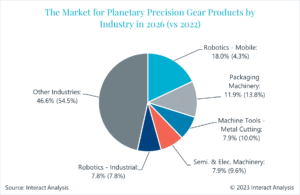
Mobile robotics is undoubtedly the fastest-growing application sector for precision planetary reducers, with a projected compound annual growth rate (CAGR) of 55% from 2022 to 2026. In contrast, sales in other sectors are projected to grow at a CAGR of less than 5%. The high growth in mobile robots is primarily driven by the increasing demand for warehouse automation. The COVID-19 pandemic has spurred the booming development of e-commerce worldwide. At trade shows in Europe, such as Hannover Messe, Automatica Munich, and SPS in Nuremberg, we have seen numerous manufacturers developing components specifically targeting the mobile robotics market. We believe that the vast majority (approximately 95%) of mobile robots using precision reducers will employ planetary reducers; a very small number will utilize harmonic or cycloid/RV reducers, as mobile robots do not require the ultra-high-precision positioning and motion required by industrial robots.